

Issue #8: In Conversation with Indonesia's Ministry of Women Empowerment and Child Protection
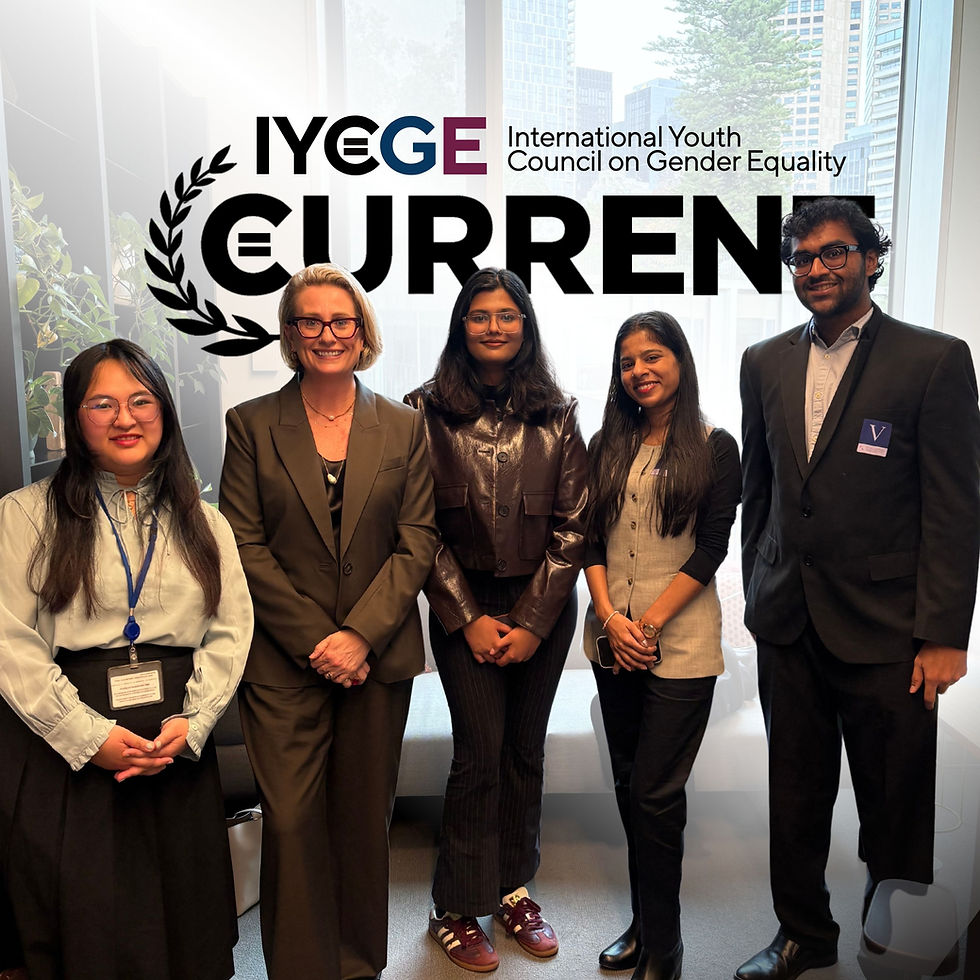
On April 13th, 2026, the Indonesian chapter of the International Youth Council on Gender Equality (IYCGE) held a dialogue with representatives from Indonesia’s Ministry of Women’s Empowerment and Child Protection (KemenPPPA). The discussion focused on national gender equality strategies, policy implementation challenges, and opportunities for youth collaboration.
The IYCGE delegation was represented by Indonesia Ambassador, Madelavina Melhan; Government Relations Fellow, Amirah Khairiyah; Research Fellows, Daneswara Rekshohadiprojo and Shinta Adelia Sukma; Public Advocacy Fellow, Flaurelia Simarmata.
The meeting began with an introduction to IYCGE as a global platform that empowers youth to contribute to inclusive societal development and promote active youth engagement in gender equality, in alignment with the United Nations Sustainable Development Goal 5 (Gender Equality). This was followed by introductions from each fellow, detailing their respective roles and ongoing programs.
The discussion opened with a key question regarding the extent to which input from village-level communities is formally integrated into Indonesia’s national gender equality policy frameworks and translated into tangible outcomes. Andreina Fara, First Expert Planner Representative from KemenPPPA, explained that the Ministry primarily operates at the level of policy, legislation, and regulation, which limits its direct engagement with grassroot communities and initiatives. To address this limitation, the Ministry has implemented initiatives such as Desa Ramah Perempuan dan Peduli Anak (DRPPA), or “Women-Friendly and Child-Caring Villages,” and its evolving framework, Ruang Bersama Indonesia (RBI), or “Shared Spaces Indonesia”.
These programs aim to strengthen gender-responsive governance and child protection at the local level by empowering facilitators and community-based volunteers to identify and report issues such as gender-based violence, child marriage, and school dropouts to the central government as well as the Ministry. The representatives from the Ministry emphasized that partnerships with civil society and youth groups are essential to expanding outreach, particularly in rural and underserved areas, and to ensuring that diverse community inputs inform national-level policy analysis.
The issue of child marriage was also a central point of discussion as it emphasized its complex and multidimensional nature, shaped by the intersection of cultural, structural, and socioeconomic factors. The Ministry representatives identified social norms and community values as the most significant barrier to reducing child marriage, noting that these norms are deeply embedded and require long-term, intergenerational change. Shifting such perspectives cannot be achieved through short-term policy interventions alone, but instead demands continued engagement across communities and institutions.
In addition, the representatives noted education and economic conditions as key drivers of child marriage. Lower levels of educational attainment limit one’s awareness of the health, social, and economic consequences of early marriage, while economic vulnerability may incentivize families to view child marriage as a solution to reducing financial burden. These factors reinforce one another, making child marriage not only a cultural issue, but a reflection of broader structural inequalities.
While long-term change relies on changing societal norms, the Ministry noted that strong political commitment at the local level–particularly from regional leaders–represents the most immediate means for progress. Effective enforcement of existing legal frameworks, including the minimum age of marriage, can accelerate reductions in child marriage when supported by decisive and consistent local governance.
Following the conversation regarding child marriage, the Ministry representatives also highlighted the importance of meaningful collaboration across multiple levels of governance to achieve three key indicators: (1) ensuring gender-responsive and child-friendly governance at sub-district/village levels; (2) strengthening effective partnerships to support the implementation of women’s empowerment programs; (3) enhancing collaboration to prevent and address gender-based violence, child labor, and child marriage. To support these goals, Indonesia’s Ministry of Women’s Empowerment and Children Protection (KemenPPPA) is working to strengthen political coordination from the central level down to provincial and district/city levels, ensuring that gender-related initiatives are effectively translated into practice.
The Ministry also expressed interest and openness to collaboration, noting that partnerships may involve relevant technical deputies depending on the specific issue area. Importantly, representatives emphasized the role of youth not only as beneficiaries, but as active agents of development–capable of initiating and sustaining impactful, long-term programs in collaboration with institutional stakeholders.
In closing, Ajeng Dwi Damarasri, Executive Secretary of KemenPPPA, underscored how the Ministry’s advocacy for gender equality must be reflected internally. This includes ensuring women’s representation within the institution, as well as equitable participation, access, and opportunities. The meeting concluded with mutual interest in continued engagement, particularly in advancing youth-led initiatives that support gender-equality policy implementation in Indonesia.



Comments