

Issue #3: In Conversation with Colombia's Ministry of Equality & Equity
Updated: Aug 18
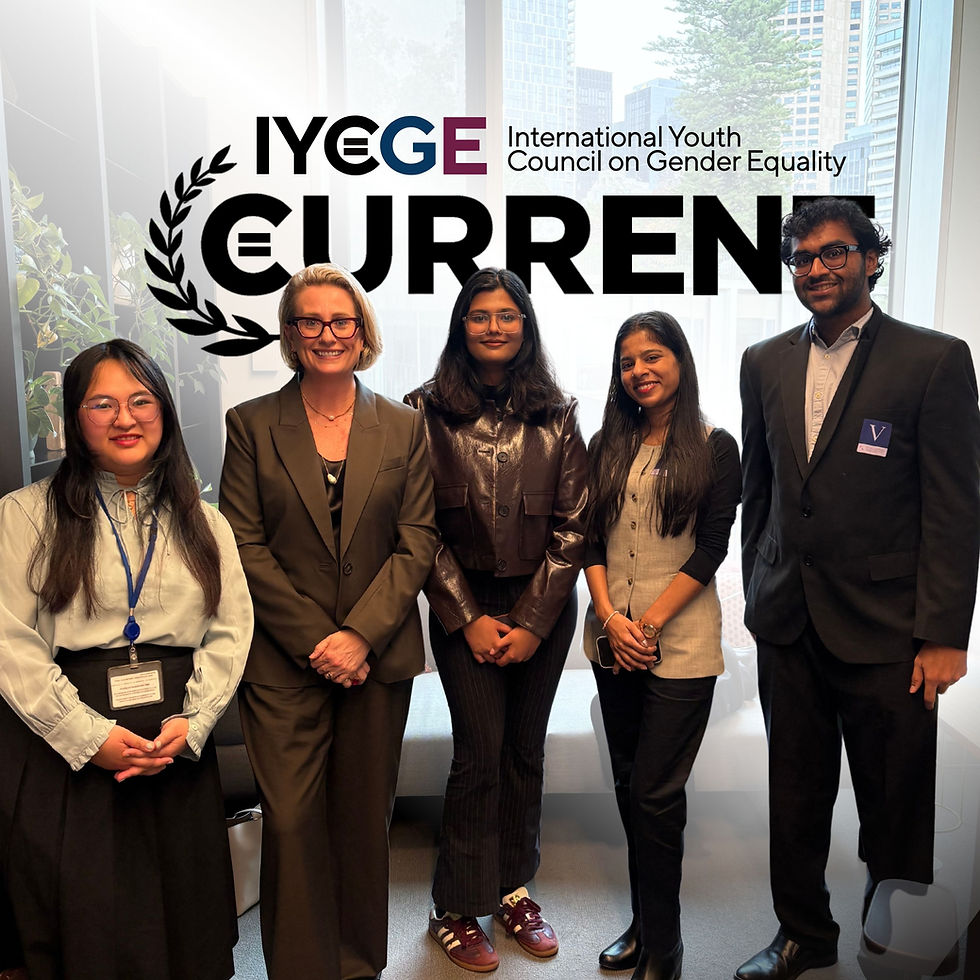
On January 29, 2026, the Colombian delegation from the International Youth Council on Gender Equality (IYCGE) met with representatives from Colombia’s Ministry of Equality and Equity to discuss national approaches to gender equality, youth inclusion, social equity policy, and inter-institutional coordination across diverse populations.
The Ministry presented itself as a central coordinating body for Colombia’s social equity policy, supporting 14 population groups through five Vice-Ministries, including women, youth, ethnic communities, LGBTIQ+ populations, persons with disabilities, older persons, and people experiencing homelessness.
Representatives noted the recent incorporation of a water and aqueduct component for smaller municipalities, transferred from the Ministry of Housing, intended to strengthen territorial and administrative equity. The Ministry is newly established and continues to consolidate its institutional structure and systems. Its current management indicators are aligned with Colombia’s National Development Plan (PND), while impact indicators are still under development. Representatives also shared that the Ministry’s long-term institutional continuity is linked to a bill currently under consideration in Congress, with institutional restructuring scenarios being assessed should the legislation not pass.
Gender equality and care policy were key areas of focus. The Vice-Ministry for Women and LGBTIQ+ populations described ongoing work to strengthen economic autonomy and access to services, with particular attention to women heads of household, women in vulnerable economic situations, and women engaged in paid sexual activities. A central initiative discussed was Colombia’s National Care System, which seeks to recognize, reduce, and redistribute unpaid care work through intersectoral coordination and expanded access to services and social protection, with the aim of improving long-term economic stability and rights guarantees.
Youth policy was also addressed, with the Vice-Ministry of Youth identified as an area undergoing continued institutional consolidation. Representatives emphasized the importance of youth participation in policy discussions and highlighted interest in engagement around inclusive peace processes and youth-focused dialogue spaces.
Data and knowledge systems featured prominently in the discussion. The Ministry described progress toward a unified observatory designed to consolidate information related to gender, violence, and populations in situations of vulnerability. This system is intended to strengthen coordination across institutions and support evidence-based planning. Collaboration with the United Nations system and other consortia through technical working tables was noted, alongside interest in partnerships with academic institutions to document processes, define research agendas, and produce comparative knowledge drawing on international experiences.
The Salvia Line (Línea Salvia) was presented as a national support mechanism for women, operated in coordination with the National Police and partner organisations. In addition to providing assistance, the line contributes to data collection and statistical production that informs prevention and response strategies. Services were described as extending to migrant and other at-risk populations.
Inter-institutional coordination was described as central to implementation. The Ministry referenced collaboration with multiple government entities and initiatives, including the National Care System, the Department for Social Prosperity (DPS), the Ministry of Culture on initiatives related to women and new masculinities, the Ministry of Agriculture, the National Police, the National Planning Department (DNP), and Bogotá’s Care Houses (Casas del Cuidado). These partnerships were framed as essential for translating policy frameworks into community-level services.
Regional and mobility-focused policy was discussed through the Border Plan (Plan Frontera), which takes an integrated approach to migrant, returnee, and border populations, considering mobility, gender, and territorial needs. This work is coordinated with the Ministry of Foreign Affairs and includes engagement with youth organisations. Participation in the development of the Plan Frontera document was identified as an area of relevance for ongoing dialogue.
Planned strategic spaces were also mentioned, including a forum within the framework of CELAC with participation from African countries, and three thematic events focused on the Care System, inclusive economic processes for ethnic communities, and women and cocoa production, in coordination with regional and trade actors.
The conversation concluded with shared interest in continued dialogue and exchange on gender equality, youth inclusion, research collaboration, and knowledge-sharing, as well as clarification of IYCGE’s potential role in future engagement processes.



Comments