

Issue #16: In Conversation with Alice Jordan-Baird
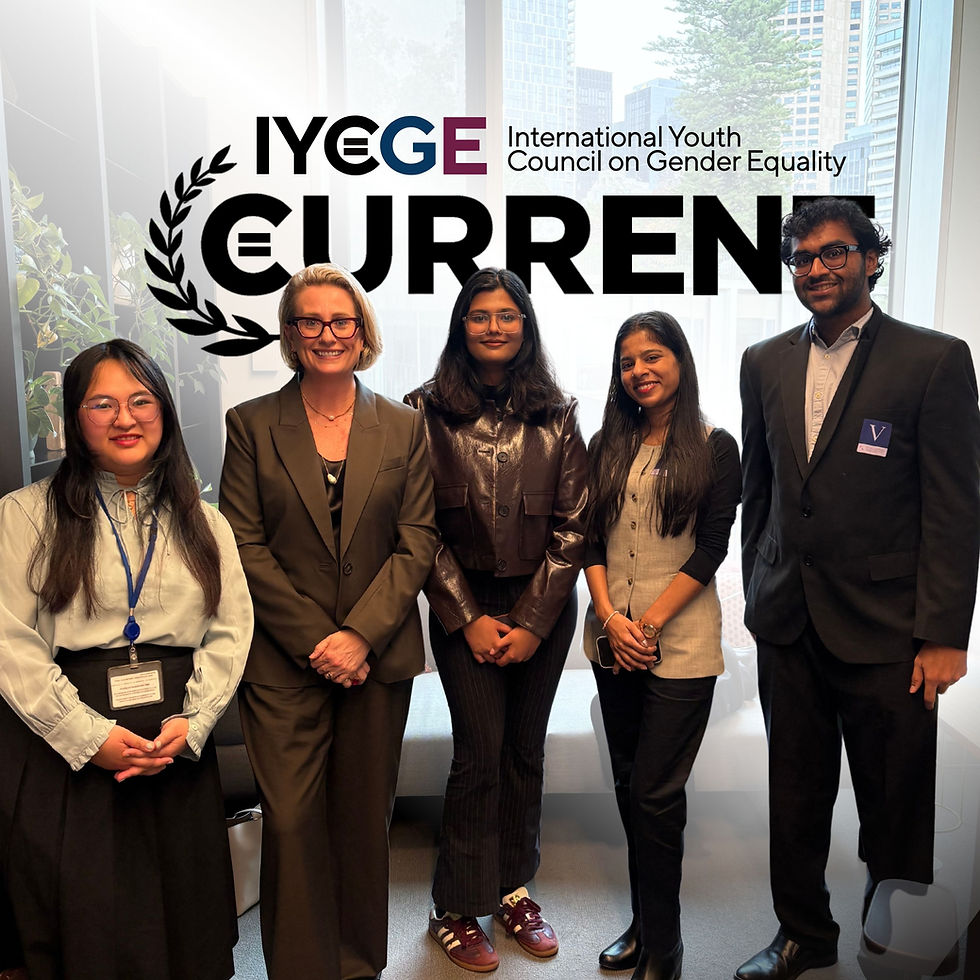
In spring, the Australian delegation to the International Youth Council on Gender Equality (IYCGE) met with Alice Jordan-Baird MP, Federal Member for Gorton, to discuss the state of gender equality in Australia. Government Relations Fellow Chatarina Hanny Angelita Teja represented the delegation. The resulting discussion centred on workplace equality, unpaid care, mental health, workplace safety, and the representation of women in senior leadership.
Alice was elected to the seat of Gorton at the May 2025 Federal Election, joining the Albanese Government's record-breaking female caucus. She is among the youngest members of the current Parliament, and is very passionate about high-quality education and accessible healthcare.
The interview began by asking Alice how diverse female representation can shape stronger gender equality policies across Australia. She drew on her first year representing Gorton as part of the most female-representative Parliament in the country’s history, comprising 49.6% of women in the federal Parliament and 56% of women in the Labor caucus. One of the ways which the Australian federal Parliament works towards gender equality is through the Women’s Budget Statement. Reintroduced by the Albanese Government in 2022, this component assesses how each Budget measure affects women and highlights women-facing government initiatives such as cheaper contraceptives, endometriosis care, and new public health clinics. Alice also spoke about how former Prime Minister Julia Gillard inspired her to represent the women and young people of her community. As part of her work, she visits schools across her electorate to encourage young women into leadership, such as the Gorton Young Leader Awards, to build a pipeline for their futures. Still, she noted that Parliament as a whole has yet to reach gender parity. She also raised concerns about misinformation, AI-generated content, and growing disconnection between young people and politics. For Alice, this was exactly why representation that reflects the country’s diversity matters, particularly for women and young people.
The conversation then moved to the matter of the gender pay gap in Australia and the cost of living. Alice acknowledged that although Australia's national gender pay gap now sits at a historic low of 11.3%, there remains considerable work to do. She notes that unpaid care and caregiving responsibilities, often carried disproportionately by women, remain one of the key factors driving that gap, and the government has put a lot of effort into addressing the issue. These efforts include increases to paid parental leave and superannuation, and expanded access to treatments for conditions such as endometriosis and menopause. Alice also spoke about the impact of Baby Priya’s Bill. Before it passed, employers could require staff to return to work days after their child is stillborn or dies. To this, Alice recounted her close friend who was expected back only three days after experiencing stillbirth. The Bill amended the Fair Work Act 2009 that clarifies the role employees have in cases where women miscarry late in their pregnancy. She also pointed to the Fair Work Commission’s reviews into female participation across industries, which have informed the government’s push to better support women in female-dominated industries.Furthermore, Alice spoke more broadly about other reforms to the Fair Work Act 2009: supporting people caring for children or people with disability, clarifying that secondary parents are also entitled to take parental leave, and confirming that breastfeeding can no longer be a basis for workplace discrimination. Beyond legislation, she pointed to cheaper and subsidised childcare as initiatives making a real difference for families particularly in Victoria's western suburbs, where she said women now have greater time and autonomy in how they participate in work and community life. Together, these changes are helping strengthen employment protections and support women re-entering and remaining in the workforce. Still, Alice was clear that there is more to do, pointing to the government's Working for Women: A Strategy for Gender Equality (2024-2034) as the next step forward.
On the topic of workplace safety and harassment, Alice reaffirmed the government's commitment to adopting all recommendations of the Respect@Work inquiry. This includes adopting a clearer legal definition of sexual harassment. She also argued that the work also requires broader shift in workplace culture such as through normalising parental leave for fathers, whilst combining that with research looking into the links between workplace attitudes and rates of sexual harassment. Drawing on her prior experience working for the Minister for Education, she discussed the introduction of mandatory consent education in schools. In particular, she emphasised the importance of early education in teaching school kids about affirmative consent, arguing that this is what shapes healthier attitudes towards women from a young age. However, such efforts must be accompanied with consistent, national implementation of respectful relationships education across school systems and jurisdiction, in line with the National Plan to End Violence Against Women and Children 2022-2032.
Afterwards, Alice discussed government reforms around mental health. She pointed to continued collaboration between the Commonwealth government and the states to improve mental health services following the COVID-19 pandemic. This includes introducing referral-free mental health support lines and the rollout of Medicare Mental Health Centres nationally, which allow people to do walk-in sessions with a psychologist without needing prior appointments. Alice also highlighted the government’s commitment to investing $90 million to train 1,200 new peer workers and professionals, as part of a broader $1 billion mental health investment plan. In addition, she cited the government's plan for a $25 billion increase in hospital funding, part of which is directed at helping states close service gaps. For instance, this includes improving phone services and online access in regional areas where physical clinics were unavailable. Suicide prevention was also cited as the government’s continuing priority, as well as tackling the stigmas around mental health across multicultural communities.
Alice concluded the interview by stating it is about “meeting people where they are.” Whether it’s about tailoring mental health support to different communities, building economic security through paid leave and workplace reform, or ensuring the next generation of women see a clear path to leadership, Alice remains deeply committed to closing the gender pay gap.
The IYCGE delegation is grateful to Alice Jordan-Baird MP for her time and contribution, and looks forward to continued engagement as both organisations work towards a more gender-equal Australia.
Written and edited by Chatarina Hanny Angelita Teja



Comments