

Issue #14: In Conversation with Martin de la Sotta
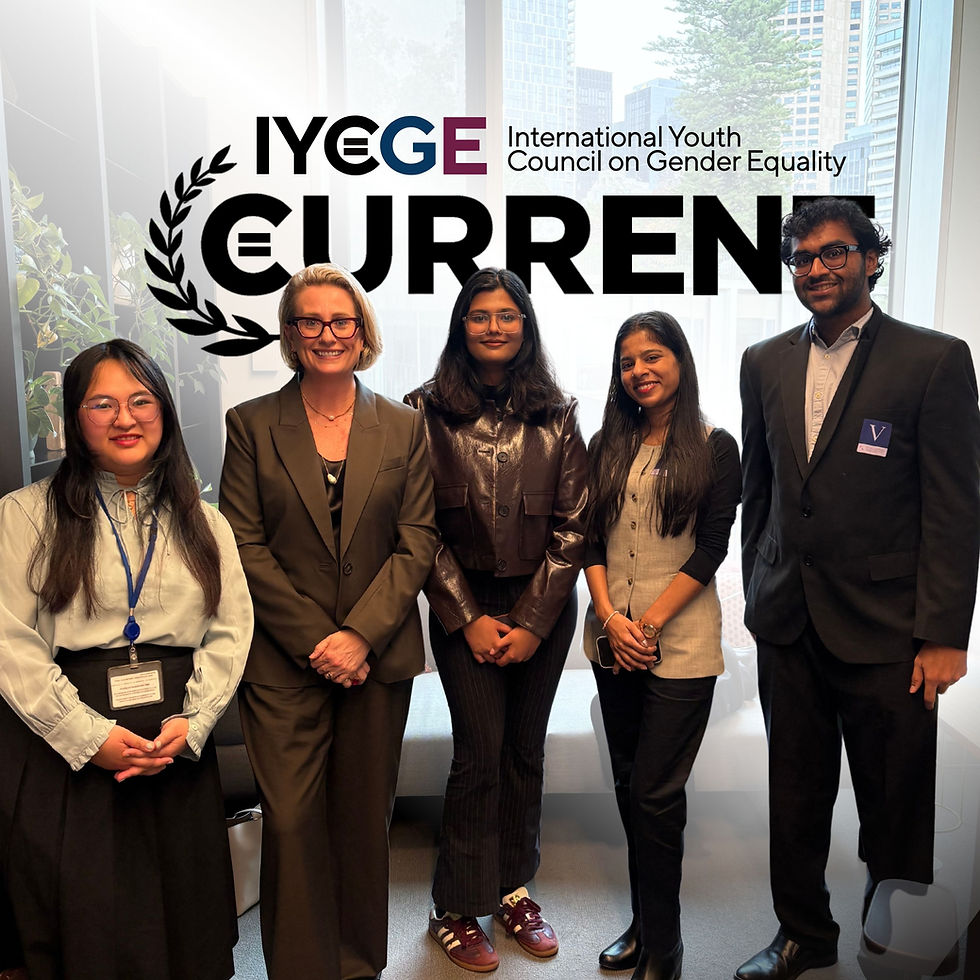
On June 24th, Martín de la Sotta met with the Chilean delegation of the International Youth Council on Gender Equality (IYCGE), represented by the IYCGE Chile National Team and the Government Relations Fellow. The discussion centred on the origins and development of the “Chile Necesita ESI” movement, the structural barriers to implementing Comprehensive Sexuality Education (CSE) as public policy in Chile, and the strategic opportunities for advancing the agenda in a complex political landscape.
Martín de la Sotta is a psychologist and holds a Master's degree in Educational Psychology from the Pontificia Universidad Católica de Chile, as well as a Diploma in Sexualities from ETSex. His work sits at the intersection of education, sexuality, and rights-based approaches to child and adolescent development.
The conversation opened with de la Sotta recounting the origins of his engagement with CSE. His involvement began in 2018, through student participation in the feminist movements at the Universidad Católica, which naturally led him toward networks advancing on a non-sexist education. He described CSE as a concept that, at the time, remained underdeveloped within academic and activist circles — consistently placed among the last items in analyses and petitionary documents, rather than treated as a policy priority in its own right. He began to approach CSE not merely as a pedagogical stance but as a distinct field of study and a different way of thinking about education altogether. The effort to socialise the concept with other academics and professionals led to the creation of an alternative school through a student competitive fund — an initiative whose quality of speakers, including representatives from the Ministry of Education, gave the topic unexpected visibility and prompted a wave of organisations to join the conversation.
The discussion then turned to why a gap persists between Chile's international commitments and domestic implementation. De la Sotta pointed to a paradox: Chile has ratified human rights treaties that contain CSE obligations — including the Law on Fertility Regulation, which mandates educational programmes on contraceptive methods, and the Law on Children's Guarantees — neither the Ministry of Education nor public policy institutions have translated these into effective, intersectional programmes. He stressed that as long as CSE is not anchored in formal study plans, ministerial coordination will remain insufficient. In the context of public services reform, he drew a parallel with other State systems such as SLEP, that could replicate with the same institutional architecture that has enabled inclusion strategies for disability but the political will to do so has repeatedly stalled or been abandoned.
On the current political landscape, de la Sotta offered a measured but hopeful reading. He framed CSE as a social right whose time is approaching, drawing a comparison with marriage equality: a cause that, over time, built the transversal support necessary to become law. He identified sectors that have shown genuine interest in the issue, including parts of the younger right, which he described as more pragmatic and more open to engaging with CSE when concrete results — reduced abuse rates,
healthier school environments — can be demonstrated. He acknowledged, however, that the opposition is not monolithic since movements such as Con Mis Hijos No Te Metas have succeeded in sexualising the debate and obscuring the cross-cutting nature of abuse prevention, creating a distorted public image of what CSE actually entails.
The conversation also included the role of families and communities. De la Sotta was careful to distinguish between organised opposition and the broader universe of families, arguing that the latter have been far more flexible than the political debate suggests. Schools that have committed to CSE — actively involving families in the process — have achieved meaningful results. He described CSE not
as an imposition but as an invitation. An invitation to families to engage with sexuality education, to heal unresolved intergenerational legacies, and to embrace new forms of teaching grounded in tenderness, intergenerational dialogue, and a shared commitment to charting the educational path forward. He also underscored the preventive dimension, noting that the reduction in adolescent pregnancy rates represents one of Chile's more celebrated public health achievements — a success that CSE has contributed to, even without a dedicated legal framework.
De la Sotta then situated Chile's experience within a regional comparative frame. He pointed to Argentina as a country with established CSE frameworks, and to Colombia as a case where a ministerial programme enabled rigorous study of CSE's developmental impact — demonstrating that investments in childhood yield measurable gains in adolescence. He noted that in Argentina, the CSE debate has become entangled with the abortion debate in ways that have complicated its public reception, and expressed the view that Chile should resist this conflation: CSE, he emphasised, is about pleasure, autonomy, and wellbeing — not only about preventing unwanted pregnancies or violence, even if those outcomes matter.
The conversation concluded on a note of qualified optimism, centred on the establishment of the Día de la ESI (CSE Day) as a practical and symbolic milestone. De la Sotta described it as a more immediately achievable solution in a context where legislative financing remains distant — a day that brings together collectives working on disability, midwifery, sexual diversity, and a wide range of intersecting issues, building the broadest possible coalition even in adverse times. While the political moment may not yet favour a comprehensive CSE law, the day signals that the infrastructure for that future debate is already being built.
The Chilean IYCGE delegation is grateful to Martín de la Sotta for sharing his expertise and perspectives. This conversation is part of CURRENT's ongoing series on the state of gender equality governance across the globe, and it is hoped that his insights will contribute to a broader understanding of the structural and political challenges facing CSE implementation in Chile and Latin America.



Comments