

Issue #15: In Conversation with MP Sarah Connolly
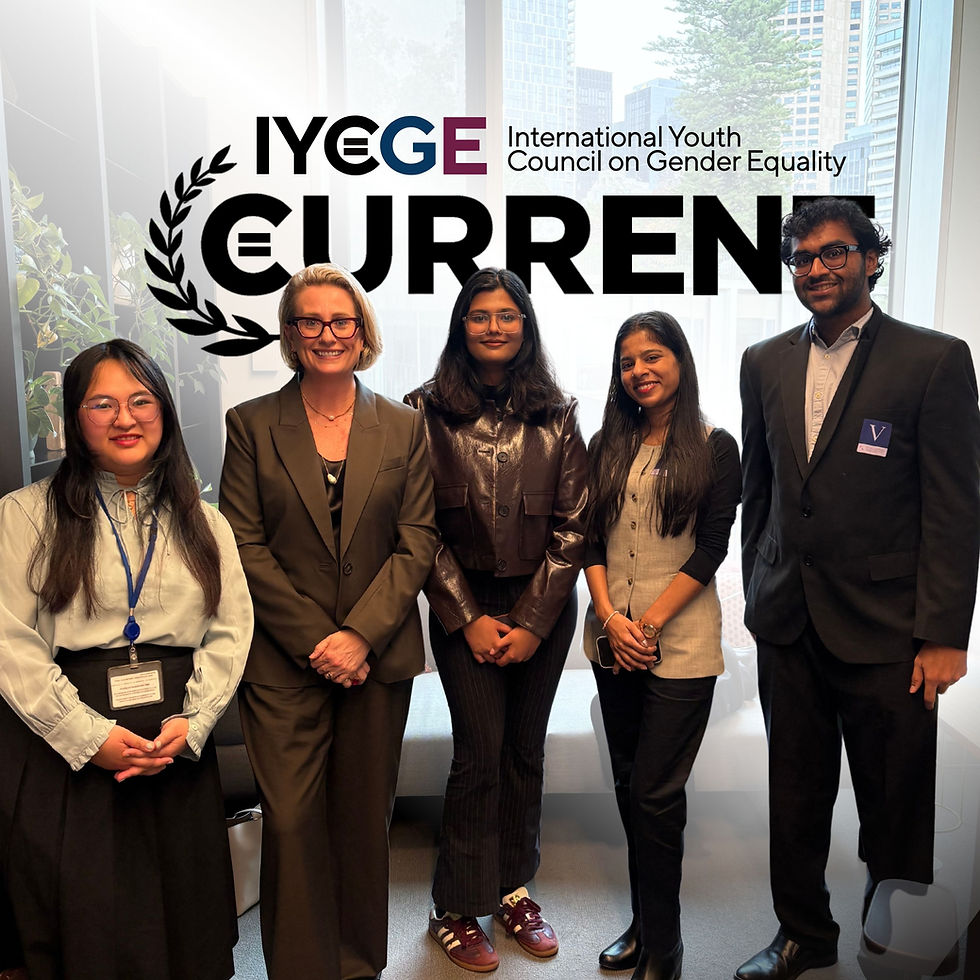
Gender Equality (IYCGE) met with Sarah Connolly MP, Member for Laverton, to discuss the state of gender equality in Victoria. The delegation was represented by Ambassador Tejasvini Adya, Government Relations Fellow Chatarina Hanny Angelita Teja, and Research Fellow Parv Haria. Our discussion centred on women's health, gender-based violence, workplace flexibility, and the barriers facing migrant and multicultural women in Melbourne's west.
Sarah Connolly MP is the Labor Member for Laverton, home to one of Melbourne's most diverse, multicultural communities. Before entering Parliament, Sarah worked across law and the energy sector.
The conversation opened on the work the Victorian government has done to push for change on women's health. On a state-level groundwork, Sarah noted that much of the infrastructure now being expanded, including the West Gate Tunnel, the Metro Tunnel, and Footscray Hospital itself, described as the largest health infrastructure investment of its kind. Sarah also noted existing gaps in women’s access to healthcare. She reflects on how women's pain has long gone unheard within the health system, how symptoms of conditions like endometriosis were routinely dismissed or overlooked by GPs.
This gap, she said, was exactly what drove the Women's Caucus in the Victorian Parliament to push for the Inquiry into Women's Pain. This landmark survey gathered the experiences of over 13,000 women, girls, carers, and clinicians, regarding the systemic gender bias, dismissal, and unmet healthcare needs that continue to shape how female pain conditions are treated across Australia. That inquiry became the catalyst for change and drove several reforms, including the establishment of specialist endometriosis clinics, expanded access to long-acting contraceptive procedures such as the Green Whistle for IUD insertion, and the expansion of bulk-billing clinics to save women time and money when renewing contraceptive pill prescriptions. She also highlighted the rollout of women’s health clinics around the state and new no-cost treatment for urinary tract infections (UTIs), a condition she noted was especially common among elderly women and those who have given birth.
Beyond clinical care, Sarah pointed to the Victorian government's work in making free pads and tampons available in every public school and across public spaces, such as train stations, libraries, and sports arenas. "People experience period poverty," she said. "We want to make sure that girls and women aren't embarrassed to have their period due to stigmas, and help those who can't afford it." She also spoke of the government’s initiative for free public IVF for women who want to have a baby, stating that “being able to afford and access your IVF shouldn’t be dependent on whether you have the money or not.”
Another issue Sarah raised was domestic and family violence. She stated that women were still experiencing abuse at the hands of their partners. In Victoria's western suburbs, domestic violence remains the highest-recorded type of crime — a pattern Sarah attributed to drivers such as low socioeconomic and generational disadvantage, and substance abuse. Additionally, Sarah states that, "crime is preventable, not inevitable,” and emphasised the importance of investing in preventative measures, such as Victoria's Violence Reduction Unit. The unit tracks children affected by domestic violence, ensuring they receive the support they need in order to prevent youth crime.
But for Sarah, closing the gender gap isn’t only about supporting women, it is also about reshaping culture more broadly. She pointed towards the creation of a Minister for Men and Boys as a step in that direction, one aimed at reshaping men's physical and mental health as a foundation for a healthier culture more broadly. Sarah also said that a gender equality lens has now been applied across every portfolio of the Victorian government, including the Department of Treasury, where a dedicated role exists specifically to assess policy through that lens.
Sarah stated that this progress was only possible due to the large number of female MPs in the Victorian Parliament. She also credited the legacy of Fiona Richardson for the Orange Door network, which now operates in every local government area to provide wraparound support for women seeking help with gender-based and domestic violence. However, she acknowledges that while so much has been done to close the gap, there is still much that needs to be done to close the gap.
The conversation then turned to women's rights at work. When asked about the state government’s move to legislate work-from-home rights, Sarah responded from a personal level. She draws on her own mother's experience moving from a low-paid childcare job into aged care work. She reflected that if her mother had been able to work from home, she could have stayed present for her kids while still earning an income, easing financial pressure on the family and putting them in a stronger economic position overall. Work-from-home rights would also allow more women to participate in and grow the economy, alongside better productivity and a healthier balance between work and home life. At the same time, she acknowledged there are still gaps that exist. For instance, there were few childcare centres open early enough in the morning, which means school-aged children were often dropped off to wait at the gate while parents rush to beat peak-hour traffic to get to work on time.
The meeting was concluded early due to Sarah Connolly MP’s other parliamentary commitments. The IYCGE delegation thanks Sarah for her time and contribution, and looks forward to continued engagement as both organisations work towards a more gender-equal Victoria.
Written and edited by Chatarina Hanny Angelita Teja


Comments