

Issue #12: In Conversation with Alicia Ziffer
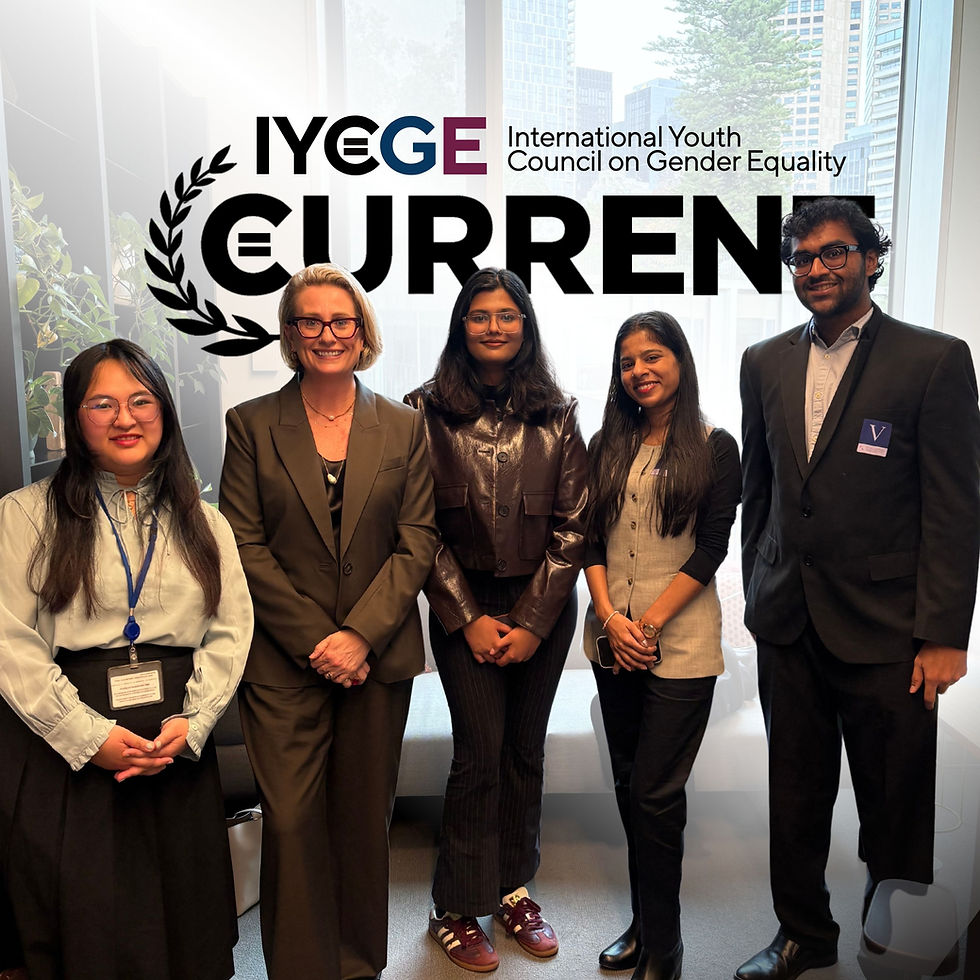
On July 15, 2026, Vineet Prakash, Coordinator of Asian Affairs at the International Youth Council on Gender Equality (IYCGE), held a virtual dialogue with Alicia Ziffer, Training Centre Chief and Knowledge Management Specialist at UN Women. The discussion explored UN Women's global mandate for advancing gender equality, approaches to capacity development and knowledge management, and the importance of contextualizing global gender equality frameworks to local realities.
Alicia Ziffer serves as the Training Centre Chief and Knowledge Management Specialist at UN Women, where she leads global efforts in capacity development, institutional learning, and knowledge management to advance gender equality and women's empowerment. With over fifteen years of experience within the United Nations system and more than two decades of work in gender, education, public policy, and social development, she has contributed extensively to designing learning strategies, strengthening institutional capacities, and supporting governments and development partners in implementing gender-responsive policies. Throughout her career, she has worked across Latin America and at UN Women's headquarters in New York, promoting evidence-based learning and knowledge exchange to accelerate progress toward gender equality.
The conversation began with an overview of UN Women's unique triple mandate, which distinguishes the organization within the United Nations system. Ziffer explained that UN Women operates through three complementary pillars: a normative mandate that supports the development of international standards and frameworks for gender equality; a programmatic mandate that assists Member States in translating these commitments into national laws, policies, and programmes; and a coordination mandate that promotes accountability across the UN system to ensure gender equality remains integrated throughout its work. Together, these three functions enable UN Women to bridge global commitments with practical implementation at the national and local levels.
The discussion then focused on Ziffer's role in capacity development and knowledge management. She explained that her work centres on equipping governments, UN agencies, and development practitioners with the knowledge, tools, and technical support needed to implement gender-responsive policies effectively. Rather than creating knowledge in isolation, the Training Centre facilitates learning by connecting evidence, practical experience, and institutional expertise, enabling partners to strengthen their own capacities while adapting global commitments to their specific operational contexts.
A key theme of the discussion was how international organizations develop programmes that remain relevant across diverse political, cultural, and social environments. In response to a question about adapting global training materials to different countries, Ziffer emphasized that local stakeholders are the primary experts on their own realities. She explained that UN Women's methodology combines global research, accumulated institutional learning, and proven programme models with the knowledge and experiences of local partners. This collaborative approach ensures that gender equality initiatives are not simply replicated across countries but are carefully contextualized to reflect local priorities, challenges, and opportunities.
To illustrate this approach, Ziffer highlighted the Safe Cities and Safe Public Spaces Initiative, one of UN Women's flagship programmes. Implemented globally for over fifteen years, the initiative works to improve the safety of women and girls in public spaces by addressing harassment, strengthening urban governance, and fostering partnerships among governments, civil society, and local communities. She noted that while the programme operates within a common global framework, its interventions are adapted to each city's specific context, demonstrating the importance of locally informed implementation in achieving sustainable outcomes.
The discussion also underscored the value of knowledge sharing in advancing gender equality. Ziffer explained that effective capacity development extends beyond delivering training sessions; it requires creating systems through which experiences, research, and lessons learned can be continuously be exchanged among institutions and practitioners. Such approaches strengthen long-term institutional capacity and support more effective implementation of gender equality commitments across different sectors.
The conversation reinforced that sustainable progress toward gender equality depends not only on strong international frameworks but also on meaningful collaboration with local actors, continuous learning, and the effective sharing of knowledge across countries and institutions.
The IYCGE is grateful to Alicia Ziffer for sharing her expertise and perspectives. Her insights demonstrate how knowledge management, capacity development, and context-sensitive programming contribute to advancing gender equality within the United Nations system. This conversation forms part of IYCGE's ongoing efforts to engage with global experts and practitioners whose work strengthens inclusive governance and promotes women's rights worldwide.



Comments